
Fifty years ago, the idea of a fund that simply bought every company in a stock market, and made no attempt to pick winners, was treated as a joke. Critics called it lazy, even un-American. Today, index funds hold a huge share of the world's invested money. This is the story of how the boring option quietly won, and what it means for your savings.

The simple idea
An index fund does not try to beat the market. It tries to be the market. If an index includes the five hundred biggest companies in a country, the fund buys all five hundred, in proportion to their size. When the index goes up 7%, the fund goes up about 7%, minus a very small fee.
The alternative is an actively managed fund, where professional managers research companies and try to buy the ones that will do better than average. That sounds like it should work. Clever, well-paid people, doing careful research, ought to beat a fund that does no thinking at all.
The most important number in investing is one you control completely: the fee.
Priya Raman
Why the simple idea keeps winning
Over long periods, most actively managed funds do worse than the index they are trying to beat. There are three reasons, and none of them is that fund managers are not smart.
- The market is everyone. Active managers are, on average, the market. For every manager who beats it, another must lag it. Before costs, the average active investor earns the average return.
- Costs come off the top. Research, salaries and trading are expensive. An active fund might charge 1% a year; an index fund might charge 0.1%. That difference comes straight out of your return.
- Winners rarely repeat. A fund that beat the market last year is not much more likely than any other fund to beat it next year.
Fees are the quiet killer
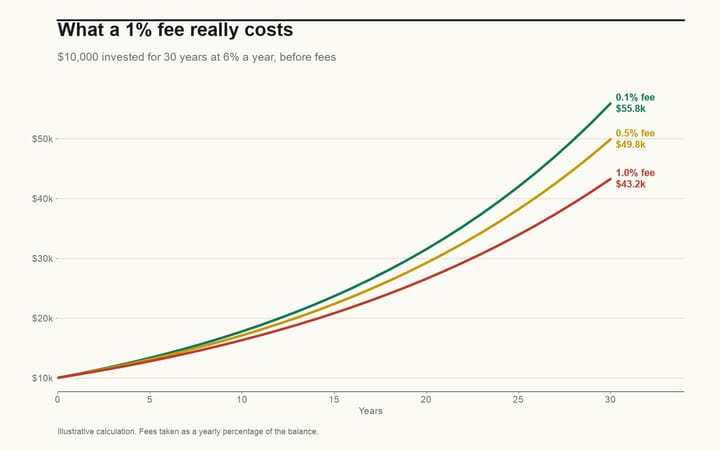
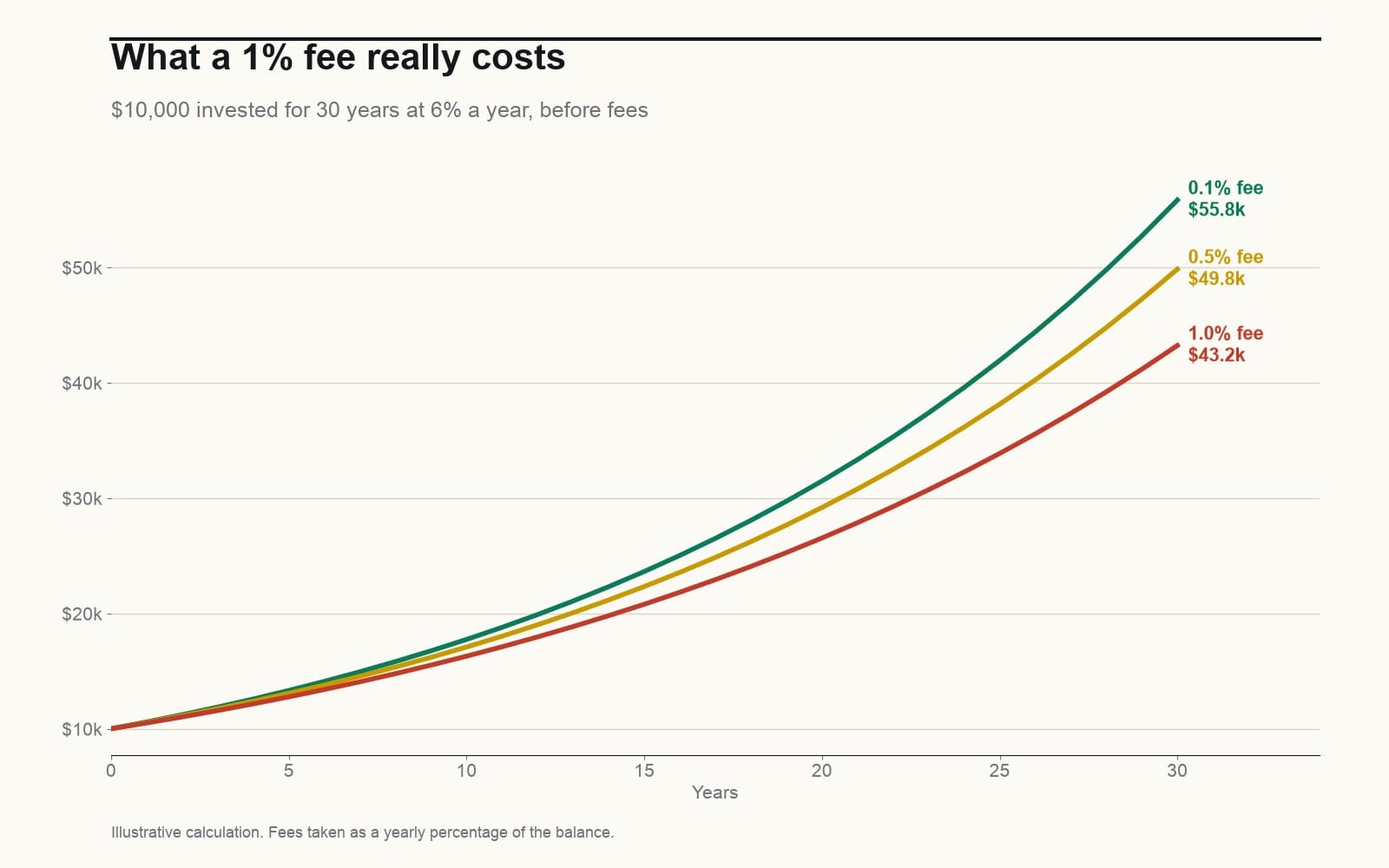
A 1% yearly fee sounds small. It is not. Because fees are charged on your whole balance every year, they compound, just like returns do. Over thirty years, a 1% fee can take a quarter of your final savings. The chart above shows the effect on a single deposit of $10,000 at 6% a year before fees.
Most people would notice if someone took a quarter of their savings in one go. Almost nobody notices when it happens slowly, 1% at a time.
The problem with picking
Picking individual shares is exciting. It is also much more like gambling than most people admit. A single company can double or halve in a year for reasons nobody predicted: a new competitor, a failed product, a change in the law. An index fund spreads that risk across hundreds of companies, so no single disaster can sink your savings.



What index funds do not do
Index funds are not magic. They fall when the market falls, sometimes sharply. In a bad year, an index fund might lose a third of its value, and it will not try to protect you. They also cannot help you choose which market to invest in, or how much to keep in shares versus safer assets like bonds or cash. Those decisions still matter a great deal.
And because index funds buy companies in proportion to their size, a few very large companies can make up a big share of the fund. That is worth knowing, even if it rarely changes the case for owning one.
A simple approach that works for most people
For most people saving for the long term, a sensible approach looks something like this: choose one or two low-cost, broad index funds, add money regularly, leave it alone for years and check the fees once a year. It is not exciting. It will never make a good story at a dinner party. But for most savers, it is very hard to beat.

What about when markets fall?
The hardest test for any index investor is a big market fall. An index fund will fall with the market, and there is no manager trying to limit the damage. Watching savings drop by a quarter in a few months is painful, and the temptation to sell and wait for things to calm down is strong.
History suggests that this is usually the moment when patience pays most. Markets have recovered from every major fall so far, although sometimes slowly, and the investors who sold near the bottom often missed the recovery. The simple, boring approach only works if you stick with it through the frightening parts.
A note on choosing an index
Not all index funds are the same. Some follow a single country, others the whole world, and some follow narrow themes like technology or clean energy. The broader the index, the more the risk is spread. For most long-term savers, a global index covering thousands of companies in dozens of countries is a sensible core.
The bottom line
The index fund won not because it was clever, but because it was cheap, simple and honest about what nobody can know. The next time someone offers you a fund that promises to beat the market, ask two questions: how much does it cost, and how often has it actually done it? The answers are usually all you need.